So common yet so underrated and often not given the importance it deserves in society are the periods (or menstruation) and their crippling effect on a huge population of women.
As the periods are a natural phenomenon happening to every person who has a uterus, which people often tend to forget is, its varying range of effects from person to person. So this article is not on why women have periods, but today I am here to help you understand why it is accompanied by various other symptoms that tend to suck the life out of you(PMS). On that note, let’s get it going.
Dysmenorrhoea is the medical term for painful menstruation. Now as much as we would usually want to assume that pain always means there is some underlying pathological cause, most of the time, it is seen to be without any underlying cause. That means there are two kinds of dysmenorrhoea—primary and secondary.
Primary dysmenorrhoea means there is no underlying pathology of the pelvic region. So why the pain, right? So, this pain is mainly due to contractions of the uterine muscles, under the influence of a chemical produced by your body known as prostaglandins. Now, these contractions lead to constriction (narrowing) of the blood vessels due to the increased pressure resulting in reduced blood flow to the uterine muscles. Therefore, no blood to the muscles means no oxygen to the muscles, a state known as ischemia. Now I guess I don’t need to specify how important oxygen is for our muscles, right? Thus, this lack of oxygen or ischemia is the cause of this pain. Now the question might be bothering you that why the pain only at the end of every cycle right, so to answer that, during the rest of the menstrual cycle the presence of estrogen and progesterone, which are the other hormones involved in the cycle, suppresses the level of prostaglandins. Towards the end of the cycle, when the body realises that there is no embryo formed, it doesn’t bother to maintain the level of progesterone anymore, and the progesterone level therefore falls. This allows the prostaglandins to rise and cause uterine contractions (mainly to flush out the endometrium lining).
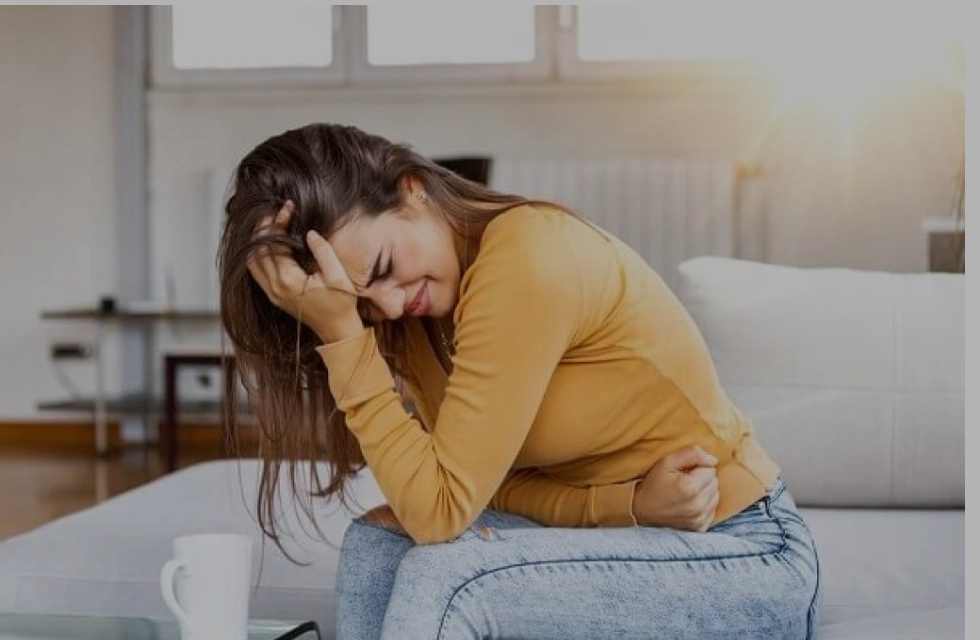
The primary dysmenorrhoea is characterized by dull, crampy ache at the bottom of the stomach, lower back, and inner thighs in some women. The pain in the back is due to something known as the referred pain. This means the pain is originating from the uterine contractions, but as the nerves supplying the uterine muscles and the back lie close to each other, the pain tends to appear at the back.
Risk factor –
● Periods onset before the age of about 12.
● Obesity
● Family history
● Smokers
● More common in women who haven’t had childbirth yet.
Secondary dysmenorrhoea – This means there is some underlying pathological cause of the pain associated with the periods.
It is characterized and diagnosed best by the well-taken history of the patient. In almost all the patients, the onset of the periods (menarche) is painless and the pain gradually appears with the progress in age mostly by the early 20s or in 30s of the patient, to gradually realise that the pain is not totally associated with the periods only, as it persists more or less throughout the month and it just tends to worsen during the time of periods.
It is Characterised by-
Bloated tummy, Bleeding in between periods and occasionally after intercourse.
The causes mainly include:
● ENDOMETRIOSIS – In this, endometrial lining cells (cells of the innermost layer of the uterus) get implanted somewhere outside the uterus (ectopic site). Now during the menstrual phase they bleed under the influence of prostaglandins, and now as this is in some location other than the uterus, the blood has nowhere to go and so gets deposited in the pelvic cavity itself, thus the pain.
● ADENOMYOSIS – It is similar to endometriosis, just the site of the deposition of the endometrial lining cells is in the uterine muscles. Therefore, blood gets collected in and around the muscles causing pain.
● Other causes – Pelvic Inflammatory Disease (may be due to some STDs), Ovarian cyst, Polyps, etc.
TREATMENT
As we can already form an idea by now, in the case of Primary dysmenorrhoea, just symptomatic treatments for the pain and discomfort are enough to provide some degree of relief, while for Secondary dysmenorrhoea, we have to first treat the underlying cause first.
Now let’s understand the treatments possible under two categories, one which can be done by the person themselves and the other is one in which they may need to consider reaching out for help from their doctors.
Self-treatment
● Posture – Lying down on your stomach or curling yourself in a kind of ball tends to have worked on quite some people.
● Heat packs or hot water bottles – This seems to relieve the period cramps quite a bit, but make sure not to keep them in direct contact with your skin as they tend to cause minor burns or permanent rash if used directly on the skin, put a piece of cloth like a t-shirt in between.
● Exercise – I may seem like a devil right now for suggesting you exercise while you are struggling to even move, but just hear me out. Just doing a little bit of stretching or yoga during your periods or even a little bit of stretching while lying on the floor tends to improve the pain by improving blood supply.
● Massage – Massaging with some warm coconut oil helps to restore blood supply into the uterine muscles, thus helping with the ischemia, thus relieving the pain.
MEDICATIONS
● The first-line drugs are something known as Non-Steroidal Anti-Inflammatory Drugs (NSAIDs). Let’s try to understand how this group of drugs works. Our body produces Prostaglandins from a substrate called arachidonic acid via enzymes known as Cyclooxygenase (COX). The NSAIDs have an inhibitory effect on these COX enzymes, thus the production of Prostaglandins is inhibited, and as a result, the uterine contractions, the main root cause of all the issues, are controlled resulting in the minimisation of the pain.
Now make sure to consume the NSAIDs when the pain starts to set in since if the pain once reaches its peak, the NSAIDs will have a hard time getting ahead of the pain and will be much less effective. Therefore, taking one loading dose of the NSAIDs and then following it up with whatever is the prescribed number of doses per day, for ex-
One over-the-counter NSAID is Ibuprofen, it is given as a Loading dose-800 mg followed by one 400-800mg every 8 hours. Make sure to continue the drugs throughout your period even when there isn’t any pain since that helps in maintaining the blood level of the drug at a certain level in your body, so even if the pain tries to peek out, your body can be ready for it.
Now if the pain sets in, in-between the two doses, then that’s a good opportunity to put some Paracetamol in as a painkiller as it alone is much less effective , but when given along with NSAIDs, it turns out to be more effective for many.
● Now if this line of treatment proves to be ineffective in easing the pain as is the case in some people, then the next best option used is Hormonal Contraceptives. These again follow the same mechanism of action, i.e., suppress Prostaglandin.
Now as much as I want to help you with this blog, but let me advise you that before taking any medication always make sure to consult your physician who has a better idea of your medical history, ongoing drugs, and allergies and thus can tell you if these drugs are safe for you or not as every one of you, my dear readers, have a unique body which respond differently to different drugs. With that note, I hope to connect with you in the next blog with something more interesting.
Understand your demon: The period pain
 Medical knowldege made easy